...an advocate of directed panspermia and has developed his own hypothesis. He believes life did not originate on Earth but was transplanted to Earth by "cosmic seeds" encased in space debris 700 million years after the formation of the Earth. He claims that these genetic seeds filled with DNA contained the genetic instructions for the metamorphosis of all life, including woman and man. He also rejects the neo-Darwinian synthesis, instead replacing it with a form of non-Darwinian evolution which he describes as a "pre-determined evolutionary metamorphosis" which is pre-programmed in DNA of all life on earth.
ADDENDUM (July 18, 2013): That ridiculous Evolution of Sexual Consciousness travesty was originally published in the "Journal" of Cosmology but later retracted due to "censorship" (only to reappear on Joseph's own site):
In the summer of 2011, the journal published an article by Rhawn Joseph entitled "Sexual Consciousness: The Evolution of Breasts, Buttocks and the Big Brain". PZ Myers made fun[12] of the article's thesis and the random images of naked women that it contained. Apparently some other people were not happy about it either, because the article was retracted moved to Rhawn Joseph's personal site (BrainMind.com) and its original page got replaced with a whiny rant decrying censorship.[13]
Shame is a negative self-conscious emotion that encompasses the feeling that something is terribly wrong with the self as a human being. Feelings of shame are a prominent factor in suicidal thoughts, behaviors, and self-harm (Hastings et al., 2002; Gilbert et al., 2010). Lately I've encountered several articles saying that shame really isn't that bad for you, after all. The first theme of these commentaries is the spectacle of public shaming, and the second theme concerns private shame as a means of social control.
The Futility of Public Shaming
One news article bemoaned the end of shame in American politics. Sex scandals, drug use, and other egregious mistakes just don't have the same permanently negative consequences they used to. If you're a powerful male politician, that is.
Those words used to add up to shame. Put them in the same sentence as a politician’s name, and they ended careers.
Not anymore. The latest batch of unlikely back-from-the-swamp hopefuls are Anthony Weiner and Eliot Spitzer. Weiner resigned his New York City congressional seat two years ago after revelations that he’d tweeted a sexually suggestive picture of himself to a woman who was following him on Twitter. Spitzer left the state’s governorship in 2008 after reports surfaced that federal investigators had tagged him as “Client 9,” soliciting high-end prostitutes.
Read more here: http://www.mcclatchydc.com/2013/07/11/196452/wheres-the-shame-scandals-may.html#.UeG5e20rgdp#storylink=cpy
Here's the list of prominent male politicians from the article:
Scott DesJarlais - pro-life doctor who had multiple affairs with patients, pushed them to have abortions
The lesson from all this: Wind up on the ever-increasing roll of tainted celebrities and re-emerge as the friendly, professional politician that vaulted you into office in the first place, and you’ll probably be OK.
"You'll probably be OK"... if you're a man. Has a female politician ever emerged intact from a federal sex scandal? Or has even been involved in such a scandal? If so, the double standard of slut shaming would likely put an end to her career. One of the few women on the state and local list is:
Minnesota Senate Majority Leader Amy Koch (R)... The married mother of one resigned from her leadership position and announced that she would not be seeking reelection shortly before four fellow Republicans indicated that she had been engaged in an "inappropriate" relationship with a male staffer. (2011).
Shaming on the Internet
How about for obnoxious offenders in the general public? Does the public shaming of those who spew idiotic sexist, racist, and homophobic comments on social media do any good?
I started retweeting people complaining about welfare, food stamps, etc. and then following it up with a previous tweet of theirs that makes them look hypocritical/dumb/etc.
I discovered that as I would retweet these, my followers would start @replying these people and let them know they were idiots. They would then delete their offending tweet.
Well, I couldn’t let that happen. So, I screenshot away.
One continuous stream of vile sexist hatred was directed at Women's Wimbledon champion, Marion Bartoli. Why? Because she's not a blond model. Even BBC presenter John Inverdale took part in the insults, saying she "never going to be a looker"... to which Bartoli responded:
"It doesn't matter, honestly. I am not blonde, yes. That is a fact. Have I dreamt about having a model contract? No. I'm sorry. But have I dreamed about winning Wimbledon? Absolutely, yes."
This is the bottom line. She won Wimbledon, and her detractors will never accomplish anything that monumental. Does shaming the immature little boys for their pathetic cries for attention help anyone?
Some of those dudes deleted their accounts (to perhaps reappear another day), but others just go on their merry way with earth-shattering pronouncements like, "I have to untangle my earphones at least 3 times a day" and "Playstation is better than Xbox."
Public shaming doesn't seem to cause any lasting change. Does it?
It’s no surprise to anyone that Twitter and Facebook are filled with vile, racist, homophobic, bigoted awfulness. Because humanity is filled with vile, racist, homophobic bigots. . . .
The consequence of these shaming sites, is that us “enlightened” folk then pile in on the bigots and abuse them and tell them how awful they are. And I’m willing to bet that the number of individuals who have rescinded what is probably years’ of built up bigotry is the same number of terrorist attacks that the Wellington airport security screeners have stopped: Zero. . . .
That’s not to say we should let people get away with awfulness, but when we publicly name and shame and by proxy invite the internet to start tormenting these people, we are becoming them. No better than they are because we now have a figure to poke a stick at.
The shame sweepstakes become more costly and damaging once we enter the world of mental illness, addiction, and difference. Yet some still argue in favor of shaming.
Has there been a resurgence of shame as a means of social control?
1. Shame is good for you! Shame is biological, so it's inevitable that those who are different or disabled will feel it. That was the premise of an article in the Atlantic, which in my opinion was complete and utter bullshit.
In response to a spate of teen suicides last year, a number of celebrities (Anne Hathaway, Justin Timberlake, Ellen DeGeneres, among others) used their visibility to castigate people who bully others. When public figures denounce bullying, they draw attention to the power of shame: A victim's experience at the hands of a bully can be so excruciating that life becomes unendurable. . . .
Everywhere we look, pride is on the march, and shame is on the run. . . .
If shame is such a bad thing, why did evolution see fit to program it into our genes? Evolutionary psychologists and sociobiologists believe that guilt and shame evolved to promote stable social relationships. According to the Oxford Encyclopedia of Evolution, "conformity to cultural values, beliefs, and practices makes behavior predictable and allows for the advent of complex coordination and cooperation." While the anti-shame zeitgeist views conformity to norms as oppressive, support for a great many of our social norms and the shame that enforces them is virtually unanimous.
For example, many would agree that fathers who walk out on their families, neglect their offspring, and fail to make child support payments should feel ashamed. Shame is the appropriate emotion for those men to feel: if powerful enough, the experience of shame might help them to fulfill their obligations as fathers and members of society.
Is there any scientific evidence that shaming deadbeat dads causes them to pay child support?
But it gets worse, with justifications for the biological and social inevitability of shame. Disabled children, little people, LGBT folks - be ashamed of yourselves! and stay in the closet.
While the efforts of all the parents in Solomon's book [Far From the Tree] to promote healthy self-esteem in their children are worthy and admirable, here is the unfortunate reality: those afflicted with a major disability will inevitably experience a sense of shame for the ways in which they are different, regardless of whether they have been shunned or actively shamed by their peers. Shame spontaneously arises from the perception of unfavorable difference, whether or not society inflicts it upon the person.
Shame springs from the knowledge that your development didn't unfold as might have been expected under normal conditions.
So here it is, according to Joseph Burgo: if you're different in any way, you should feel ashamed for who you are. For simply existing in a less than perfect state. Because you are "pre-programmed" to feel that way.
Here's what I think: shame is a toxic social construction. It's used by religions to control the sexual behavior of their congregations. It's used by bullies to promote their social standing over the weak. It's used by parents to ostensibly make their children into high achievers, but they end up depressed, anxious, eating disordered. It's used by the media to make women (and men) so ashamed of their bodies that they go out and buy products to lose weight, improve their looks, enhance their private parts. Shame seems to hold a central role in the perception of an adverse self-image in young women with eating disorders (Franzoni et al., 2013).
2. Shame is good for you! Addiction is a choice, so those who have a substance use disorder should be shamed into getting clean and sober. That was the territory covered in a 2007 Slate article by Sally Satel and Scott Lilienfeld, authors of Brainwashed: The Seductive Appeal of Mindless Neuroscience. An old blog post by Dirk Hanson at Addiction Inbox pointed me to their essay, which took exception to the notion that addiction is a brain disease:
A full-scale campaign is under way to change the public perception of drug addiction, from a moral failing to a brain disease. Last spring, HBO aired an ambitious series that touted addiction as a "chronic and relapsing brain disease." In early July, a Time magazine cover story suggested that addiction is the doing of the neurotransmitter dopamine, which courses through the brain's reward circuits. And now Congress is weighing in.
Addiction is defined as a chronic, relapsing brain disease that is characterized by compulsive drug seeking and use, despite harmful consequences. It is considered a brain disease because drugs change the brain; they change its structure and how it works. These brain changes can be long lasting and can lead to many harmful, often self-destructive, behaviors.
Characterizing addiction as a brain disease misappropriates language more properly used to describe conditions such as multiple sclerosis or schizophrenia—afflictions that are neither brought on by sufferers themselves nor modifiable by their desire to be well. Also, the brain disease rhetoric is fatalistic, implying that users can never fully free themselves of their drug or alcohol problems. Finally, and most important, it threatens to obscure the vast role personal agency plays in perpetuating the cycle of use and relapse to drugs and alcohol.
And now we get to their justification for shaming:
Finally, dare we ask: Why is stigma bad? It is surely unfortunate if it keeps people from getting help (although we believe the real issue is not embarrassment but fear of a breach of confidentiality). The push to destigmatize overlooks the healthy role that shame can play, by motivating many otherwise reluctant people to seek treatment in the first place and jolting others into quitting before they spiral down too far.
Really??? There is absolutely no evidence that shame motivates an addicted person to seek help. Quite the contrary, shame prevents people from getting the treatment they need (Wiechelt, 2007). Note that shame is different from guilt - with shame you're a bad person, and with guilt you did a bad thing. Why would shaming someone already filled with shame about their own undesirable behaviors be a motivating force for change?
Embarrassment over an excessive-drinking session doesn’t necessarily lead to more sobriety.
In a study of alcoholics and relapse rates, researchers found that the more shame-ridden a drinker looked when talking about drinking — interpreted through body language like hunched shoulders — the more likely he or she was to relapse and the more drinks he or she downed during that relapse. . . .
The results add to a body of literature suggesting that widely used shaming and humiliating methods of treating alcohol and other drug problems — such as those seen on shows like Celebrity Rehab — are not only ineffective but also may be counterproductive.
For example, a review of the research on the use of humiliating, confrontational tactics, which attempt to induce shame, found that none of the studies done in four decades supported this approach. In one study included in the analysis, the more the counselor confronted the client with past mistakes or other shaming information about his problem, the more the client drank.
So let's not challenge the anti-shame zeitgeist or encourage public shaming of those with addictions, mental illnesses, disabilities, or differences of any sort.
Gilbert P, McEwan K, Irons C, Bhundia R, Christie R, Broomhead C, & Rockliff H (2010). Self-harm in a mixed clinical population: the roles of self-criticism, shame, and social rank. The British journal of clinical psychology / the British Psychological Society, 49 (Pt 4), 563-76 PMID: 20109278
But note that Lewis holds more nuanced views than his categorical statement indicates (e.g., "it's accurate in some ways"),2 and Szalavitz has reported on predispositions towards addiction that are based on pre-existing differences in brain structure.
Arguing that addiction is either completely a matter of choice or entirely caused by a faulty brain misses the complexity of a person with a brain in a social environment.
Like depression, addiction is a real medical disorder that affects the brain. But if we want to reduce the stigma associated with it, emphasizing recovery and resilience is probably more useful than focusing on definitions of brain disease.
2 The entire paragraph from Lewis is worth quoting:
What’s wrong with this definition?
It’s accurate in some ways. It accounts for the neurobiology of addiction better than the “choice” model and other contenders. It explains the helplessness addicts feel: they are in the grip of a disease, and so they can’t get better by themselves. It also helps alleviate guilt, shame, and blame, and it gets people on track to seek treatment. Moreover, addiction is indeed like a disease, and a good metaphor and a good model may not be so different.
The eighth and final season of the hit series Dexter takes a scientific look at serial killers. British actress Charlotte Rampling plays Dr. Evelyn Vogel, a neuropsychiatrist who has written the definitive book on the brains of psychopaths. She's consulting with Miami Metro Homicide on an unusual case where the killer saws open the skull post mortem and scoops out part of the brain (with a melon baller).
Neuroscience is depicted as a somewhat ghoulish yet artistic and stylish endeavor (the corpse with a sawed off head is not shown in this still). This autopsy scene is particularly artsy with its use of red lit retro cabinetry and colorized MRI films on an old school light box.
Dr. Vogel is philosophical about her chosen field. In a conversation with our favorite serial killer and "blood spatter guy" she says:
"I was drawn to forensics too, but I chose to focus on neuroscience. Psychopaths. We both chose murder. Maybe we're both a little crazy."
"Maybe," Dexter replied.
Dr. Vogal continued: "Mad scientists' strange look at this -- a biological mass -- a body part -- yet somehow from all those firing of neurons something intangible emerges -- emotions, trust, morality, love. Unless you're a psychopath. But even then belief systems emerge."
WARNING! Fake grisly fake image below the jump reveals the role of the anterior insula in psychopathy.
"Looks like a piece of it has been scooped out," says Dexter at the crime scene.
And indeed, a piece of insular cortex has been scooped out with a melon baller. Looks like someone is trying to send Dr. Vogel a message. And a collection of insulae in jars...
At the police station, Dr. Vogel points out what is supposed to be the insula on a bizarre-looking MRI scan (the sawed off skull is presumably slapped back onto the rest of the body, and the genu of the corpus callosum and the ventricles look odd).
"See this part here? That's the anterior insula cortex, the portion of the brain that processes empathy. And, the hallmark of a psychopath is -- they have no empathy."
The Neurocomplimenter is a new project designed to counter gratuitous anti-neuroscience sentiment. It’s part of my campaign to combat pop neurobashing profiteers.
After seven years of critical neuroblogging, it’s time to highlight the positives:
“That was a fantastic study! Good show!
The project started with two inaugural posts hosted at a different locale:
Motor Cortex and Monkeys are Responsive to Statistical Regularities of Letter Strings
A cool new study in the Journal of Cognitive Neuroscience questions the notion that the premotor cortex response to action words is due to implicit motor simulation (de Zubicaray et al., 2013). Previously, the conceptual representation and/or simulation of action words in motor regions of the brain has been taken as evidence for embodied theories of language comprehension (Glenberg & Kaschak, 2002). These theories have been based on fMRI and EEG experiments showing that reading or listening to verbs that depict actions of the face, arm or leg activate somatotopically-specific regions of motor cortex (Hauk et al., 2004).
Their novel fMRI study showed that the motor cortex response to action verbs was actually due to ortho-phonologic probabilistic cues to grammatical class (de Zubicaray et al., 2013). In other words, the spelling and pronunciation of word endings influenced activity in motor regions of the brain. This does present a problem for grounded theories of language comprehension...
A number of scientists have been vocal proponents of study pre-registration, in which detailed methodological and statistical plans for an experiment are registered in advance of data collection. The admirable goal is to eliminate questionable research practices such as failing to report all of a study's dependent measures, deciding whether to collect more data after looking to see whether the results are significant, and selectively reporting studies that 'worked.' Along these lines, the journal Cortex has recently launched a new type of article called Registered Reports, largely through the efforts of Dr Chris Chambers:
Unlike conventional publishing models, Registered Reports split the review process into two stages. Initially, experimental methods and proposed analyses are pre-registered and reviewed before data are collected. Then, if peer reviews are favourable, we offer authors “in-principle acceptance” of their paper. This guarantees publication of their future results providing that they adhere precisely to their registered protocol. Once their experiment is complete, authors then resubmit their full manuscript for final consideration.
Many of these same researchers are also strong advocates for publication reform, some even calling for journals to be eliminated altogether in favor of post-publication, crowd-sourced review and reputation ranking. But supporters of both pre-registration and the Open Science Framework haven't yet utilized its capability to submit their new work (as opposed to the Reproducibility Project for replications).
Since calls for pre-registration of basic research studies have been ongoing for years, perhaps its proponents have been too conservative with taking matters into their own hands. One might even say there's a distinct lack of risk-taking among the strongest believers. What's to prevent them from pre-registering studies in public databases or on their own blogs (without formal peer review but perhaps soliciting comments)? Or publishing a Study Protocol in a BMC journal (like @SallyScientist did)?
Have we all been brainwashed about brain images? Amid dazzling insights and daily advances into the workings of the mind, they also may engrain mistaken ideas about human nature, a book warns.
Will we see a reactionary resurgence of dualism as a result? In my previous post we learned that the brain is not the mind, according to David Brooks.1 Hopefully that was an isolated incident.
Take the USA Today article above. It wasn't an egregious offender, yet it used an unfortunate mixed metaphor to make a point:
The brain is the temple of the mind, but are images of it in action a little over-worshipped?
The 'temple of the mind' terminology was from a Nature News story on the structure of the rat glutamate receptor GluA2. I found it bizarre that a reference to an article on protein crystallography, a method that produces an atomic-level picture of a single protein, was being used to prop up the 'seductive allure' of human brain images (a finding which hasn't replicated). In turn, someone decided that 'temple of the mind' was an appropriate way to describe the structure of the GluA2 receptor.2
...Tallis's beef is not just with crude methodologies. In detail so pitiless it threatens to be unreadable in parts, Aping Mankind argues that neuroscientific approaches to things like love, wisdom, and beauty are flawed because you can't reduce the mind to brain activity alone.
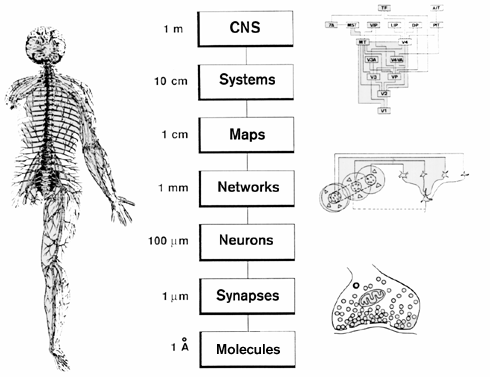
I believe that the brain is the ultimate arbiter of behavior (and that "the mind" is ultimately reducible to brain activity), but this doesn't preclude the view that interpersonal and social factors influence people's actions. Does anyone actually think that brains exist in isolation from any complex external influence (other than sensory stimulation)? It's a false dichotomy and a straw man argument foisted on neuroscientists by the neurotrashers. There are many different levels of analysis within the field, from molecules to synapses to systems to behavior.
Graduate neuroscience programs are interdisciplinary in nature, and subfields like Cultural Neuroscience and Neuroanthropology are on the leading edge of incorporating culture into brain function (and vice versa). But very few fields cover that broad a scope.
Scientists and scholars in various disciplines generally do specialized research based on narrow areas of expertise. Are historians negligent because they're not incorporating knowledge of the brain into their analyses of past events? Of course not. So why are neuroscientists remiss if they fail to include detailed sociological and developmental accounts of crime in their Human Brain Mapping journal articles? 3
It's not surprising that each discipline privileges one level of explanation over another. The danger lies in discarding all other explanatory models in favor of your own. This also holds for theorizing within a field.
2 And this stemmed from the authors' statement that the ion channel at the bottom of the GluA2 receptor is shaped "like a Mayan temple" (not that the 'temple of the mind' had been unlocked).
3 Admittedly, I used a controversial example here -- Increased executive functioning, attention, and cortical thickness in white-collar criminals -- to make a point. Is it completely wrongheaded to conduct group studies on neural differences in the brains of criminals, or does the real problem emerge if you try to predict an individual's future behavior based on brain structure? Here's an evisceration by our friend Dr. Tallis:
The crudity of Adrian Raine's opening arguments in The Anatomy of Violence – his manifesto for neurocriminology – is curiously refreshing. It is a long time since evolutionary psychology was served so neat.
It is probably impossible to look at a map of brain activity and predict or even understand the emotions, reactions, hopes and desires of the mind.
The first basic problem is that regions of the brain handle a wide variety of different tasks. As Sally Satel and Scott O. Lilienfeld explained in their compelling and highly readable book, “Brainwashed: The Seductive Appeal of Mindless Neuroscience,” you put somebody in an fMRI machine and see that the amygdala or the insula lights up during certain activities. But the amygdala lights up during fear, happiness, novelty, anger or sexual arousal (at least in women). The insula plays a role in processing trust, insight, empathy, aversion and disbelief. So what are you really looking at?
...the people who showed up at the Social and Affective Neuroscience Society’s conference in Lower Manhattan last weekend were so damned young, hip and attractive.
As science writer Ed Yong quipped: "David Brooks attacks his own oeuvre but probably doesn't realise he's doing it."
...the uses and abuses of neuroscience and brain imaging. Sally and Scott describe their book as an anchor in this discussion to expose "MINDLESS NEUROSCIENCE" and also as a critique of the assumption that the brain is the most important level of analysis for understanding human behavior.
Brooks began by talking about himself, presenting a revisionist history of his own pop neuro cheerleading, saying that in his own writings neuroscience didn't help that much, but experimental psychology helped him a lot.
"I wrote a book a few years ago about mindless neuroscience, and it did very well, so you can explain the seductive appeal of that book."
... "I started a book that I thought was going to popularize neuroscientific findings and how it'd apply to public policy and the sort of things that apply in this world, the world we deal with here in this building [the American Enterprise Institute]."
The Positive Side of the Cognitive Neuroscience Revolution
Brooks asked each of the speakers about the bright side of brain science "before we talk about the extremism." What follows below are my notes and paraphrases of the conversation.
Lilienfeld said the field was "brainless" when he came of age in the 80s and 90s -- genetics could not possibly cause behavior. Environmental factors were the primary causes of autism and schizophrenia. [NOTE: I found this a bit odd, since he attended graduate school at the University of Minnesota, site of the famous Minnesota twin studies. But I wasn't there, so what do I know.] Ultimately, injection of neuroscience was helpful, he said.
Satel mentioned the 70s biological revolution in psyschiatry. In her fields of addiction and PTSD, she felt things were too biological. She worked with Vietnam veterans with PTSD, noting both a biological component (failure of fear extinction, adrenergic system, hypothalamus, etc.) plus a profound existential dimension -- a challenge or threat that undermined integrity -- "the meaning they attributed to it was as important as the mechanism, and they both interacted" -- we should come back to somewhere in the middle. "Not to lose the mind in the age of brain science."
Democrat Brain, Republican Brain
A bit of conservative humor was injected into this portion of the conversation. Brooks mentioned the infamous This Is Your Brain on Politics opinion piece that masqueraded as actual science. "Very good pictures, aside from the fact that one is obviously a lot larger, more crenulated." [NOTE: perhaps he meant convoluted?]
"Was that a typically accurate story? If we scanned the brains here [AEI] and the Brookings brains would we see a big difference?"
Lilienfeld: "No." Ha ha [laughter].
Satel: "Yeah, ours would be bigger." Ha ha. She said that article ...was a bit of a fiasco -- one of the articles that called our attention to this. Almost read as a parody. Made a mockery of fMRI.
Free Will and Addiction
This might be considered the most controversial portion of the program, since it had policy implications. Brooks called the highbrow version of determinism "nothing but neurons" (Brian Appleyard - "nothing but-ism"), where neuroscience will replace psychology. [NOTE: There is well-articulated philosophical version of this view called eliminative materialism.] So we have no free will.
Satel (being more measured and erudite than Brooks) said there are a lot of steps in there... We're materialists, decapitation will prove it.
Which phenomena are best observed at level of the brain vs. at the level of the mind? Satel said that addiction illustrates the problem of 'neurocentrism' (neurons genes transmitters proteins) -- it's a good approach for curing Alzheimer's disease but not for dealing with addiction. Neural underpinnings underlie addiction, sure, but if you're a clinician or a policy maker is that the best way to interact with patients or develop policies? NO, she said. Regarding those with addictions: "in some ways their situation is fundamentally voluntary - let me define that - it's not easy to throw away that meth pipe but do these brain changes make them so helpless or out of control that they can't modify their behavior in response to reason or incentive or consequences?"
Brooks asked how do we define the boundary in this case?
Satel answered that "most people do overcome their addiction" - she referred to the clinician's illusion - they see the worst patients who have comorbidities - but "most people make a choice" - life is hard - essentially it's a self-medicating enterprise. In essence, she suggested that most people quit drugs/alcohol on their own, and that it's a matter of free will. Propensities for addiction and changes in the brain due to substance abuse be damned.
Lilienfeld said that the free will vs. determinism debate will not be resolvable any time soon. Interestingly, he holds the view that neuroscience does not inform free will debate, because it still doesn't say whether there's a ghost in machine even if determinist. [NOTE: uh....] There's no question that people make decisons in everyday life -- but rarely does addiction make it impossible, he said.
Writers on addiction like Maia Szalavitz and Dirk Hanson might be interested in responding to this point of view.
The Q & A with a bunch of old white guys in the audience (and three young white guys) was about half way through the video.
There we learn that Lilienfeld is a reductionist but not an eliminative materialist. An interesting point comes up when he addresses RDoC, one that somewhat questions his reductionist credentials. He's afraid of privileging biological indices as best way of measuring a psychological system. "If you want to find out if someone's an impulsive person, you ask them 'are you an impulsive person?' or you could give them laboratory tests and brain imaging. Will the latter tests give more information that just asking them and their families? We don't know that," he said.
Brooks blurts out, "That seems ridiculous to me! If you want to take an impulsive person you flick them on the ear and see what they do."
Or perhaps you give them a microphone and a column in the New York Times and see what they do...
Satel ends the conversation by mentioning their book's contribution to general neuroliteracy and "...how these levels of analysis can be bridged.1 ... ...it's a highly dynamic system that goes back and forth, and not to get seduced by these beautiful pictures which led to our preferred title, which was 50 Shades of Grey Matter." 2
-- Scott Lilienfeld received his BA in Psychology from Cornell University in 1982 and his PhD in Clinical Psychology from the University of Minnesota in 1990.
-- Sally Satel [PDF of CV] received her BS from Cornell University in 1977, her MS from the University of Chicago in 1980, and her MD from Brown University in 1984.
So that's the movie version of the book (which I have not read, other than excerpts). Neuroskeptic wrote an actual book review:
I wanted to dislike this book.
You see, I was suspicious of the fact that one of the authors is a resident scholar with the American Enterprise Institute (AEI), an organization whose political values I oppose, and, insofar as it’s an organization with political values, has little business going near science.
Then, when I found that the book cites me (with fellow neurobloggers Mind Hacks and Neurocritic) in the Acknowledgements and elsewhere, that actually made it worse. A sense of intellectual possessiveness joined my ideological reasons for not liking the thing.3
I was hoping that it would be dreadful so that I could unleash the venom I had brewed up: “Ayn Rand, Please Get Off My Bandwagon”; “The only good bits here are the bits they stole from me” – it would have been glorious.
However, sadly, Brainwashed turned out to be good.
As usual, the book was better than the movie.
Footnotes
1 Those "levels of analysis in neuroscience" figures are as old as time, so there might not be much new ground covered there. Behavior is an explicit part of many of these. It's not a new concept to cognitive scientists, either.
3 I reacted the same way when I first read an excerpt of the book in Salon (Pop Neuroscience is Bunk!). I had blogged about at least 18 of the examples given in that excerpt alone, so I felt that someone else had written a book based largely on neuroblogs (mine and others).